
Mobile Coverage
5G is being rolled out across the country and is already available in many areas. It will bring a range benefits, not least broadband-like speeds, along with a range of new applications.
Mobile and broadband coverage checker
Find out what broadband speed and mobile signal strength is available at your address.
Enter your postcode into Ofcom’s Broadband and Mobile Coverage Checker to see which providers offer services in your area, compare mobile network coverage, and check how reliable your connection is likely to be.
Benefits of 5G
The next generation of mobile devices are normally 5G enabled as default, but providers may need to install new equipment and masts across the county for residents and businesses to benefit.
Benefits include:
Faster download speeds
The most obvious benefit of 5G is faster speeds (download and upload) on the go. Potentially up to 100 times faster than 4G. This means quicker and higher amounts of data transfer and smoother streaming.
Better back-up connectivity
Ideal for those working without a stable or fast enough broadband connection or streaming multiple devices at once (multiscreen household).
Greater innovation
5G will be a key enabler for emerging technologies such as AR (Augmented Reality) and VR (Virtual Reality), and the development of smart cities and towns. In the future, firefighters could use AR-enabled glasses to navigate smoke-filled, zero-visibility incidents more safely and effectively. Meanwhile, drones could transmit real-time data, reducing delays caused by data collection, download, and processing, while minimising the risk of human error.
More responsive internet connection (Lower Latency)
The lower the latency, the more responsive the internet on your device is. 4G is typically 30-40 milliseconds (ms) while 5G is under 10ms sometimes as low as 1ms. This is crucial for applications like real time online gaming and self-driving/autonomous vehicles.
Better connectivity in crowded areas
5G networks can support a much large number of devices and connections simultaneously without a significant drop in performance. This will allow you to stand in a crowded place like a festival and still be able to send and receive information almost instantly.
IoT (the Internet of Things)
5G will play an important role in enabling IoT across a range of developing areas including automated vehicles, air quality monitoring, and traffic management and a whole plethora of new and developing tech.
Improved reliability
With a 5G network being readily available and very unlikely to experience service drop out or lag, it could be relied on for robotic surgeries and industrial automation.
Economic growth
5G is expected to drive economic growth by enabling new industries, creating jobs, and fostering innovation. This will allow more industries to move out of London and other big cities and into the home counties.
There will be many other benefits, and these will continue to evolve as the technology matures and expands. Use the 5G coverage checker to search for 5G in your area.
5G and health concerns
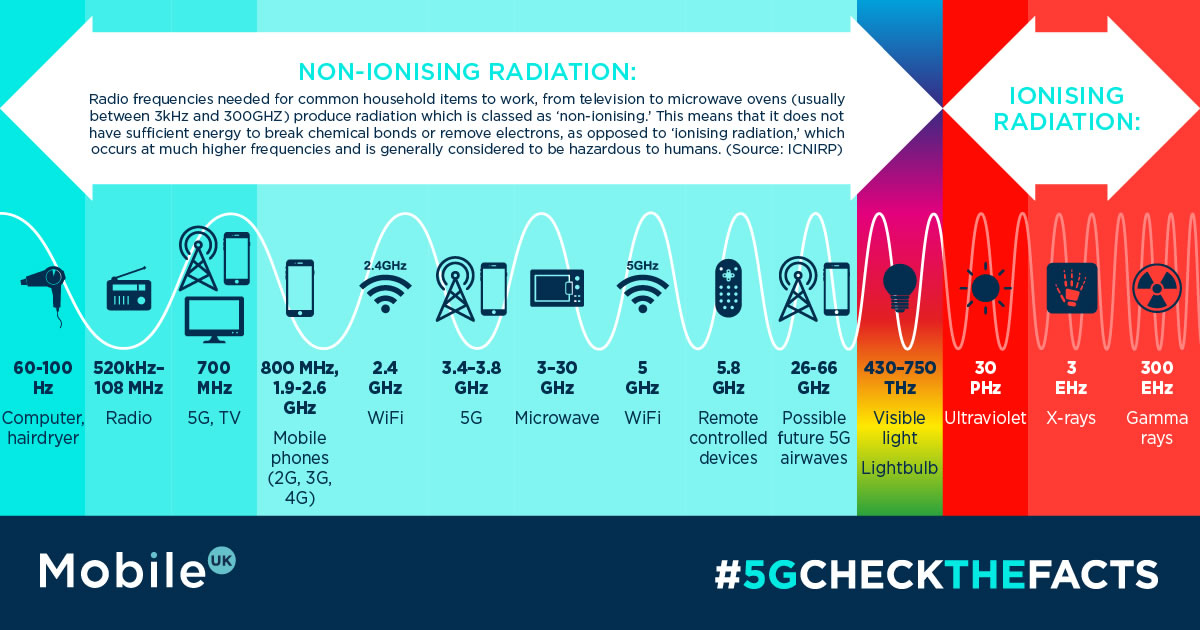
Radio frequencies used by everyday technologies, from televisions and radios to mobile phones and microwave ovens, produce what is known as non-ionising radiation.
This means that it does not have sufficient energy to damage cells by breaking chemical bonds or removing electrons, as opposed to ‘ionising radiation’, which occurs at much higher frequencies and is generally considered to be hazardous to humans (source: ICNIRP).
The diagram below shows where different types of radiation sit on the electromagnetic spectrum, from low-frequency waves produced by household devices and mobile communications, including 5G, through to higher-frequency ultraviolet light, X-rays, and gamma rays, which are classified as ionising radiation.
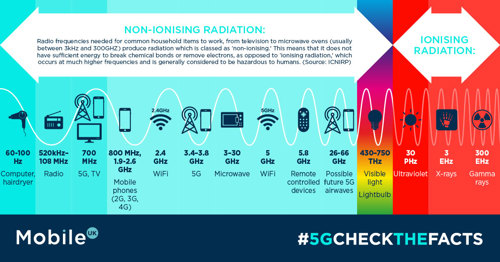
View in full screen
Image taken from mobileuk.org
Older technologies
Mobile services in the UK currently use 2G, 3G, 4G, and 5G technologies.
Providers have begun switching off 3G networks, which may impact users with older devices. This will make way for faster, more reliable 4G and 5G networks.
Each provider has its own timeline:
Vodafone and EE completed their 3G switch-off in early 2024.
Three has switched off 3G across most of the UK.
O2 plans to switch off 3G in 2025.
Your provider will contact you if changes affect your service, and you can check their website for updates.

Get in touch
Sophie Mance is Senior Project Manager for Digital Hertfordshire.